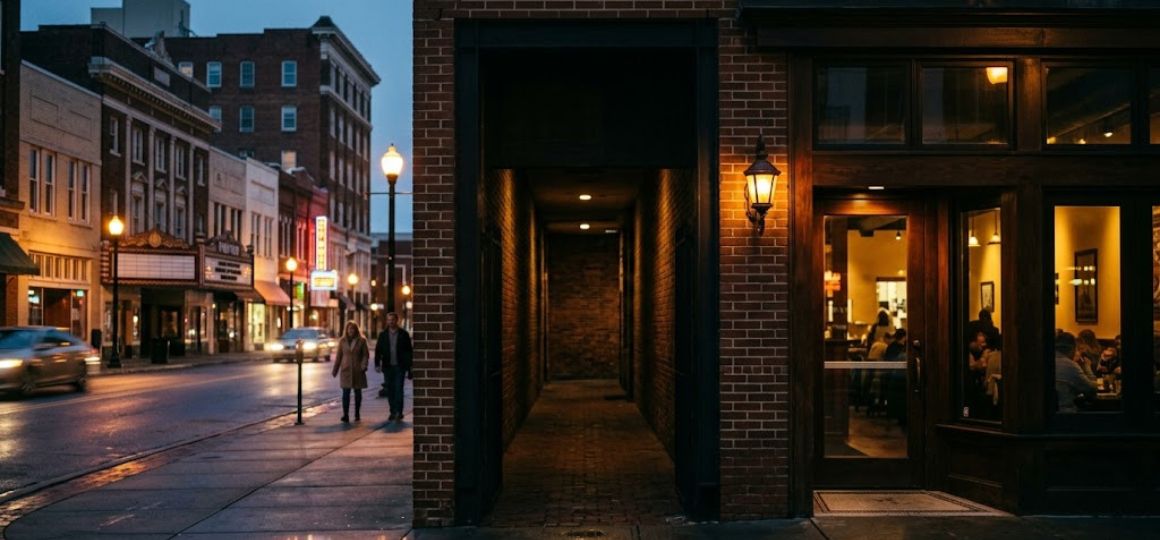
Why downtown Greensboro has a structural rat problem, not an individual sanitation problem
Dumpsters are the main draw. So are grease bins. Loading docks too.
Most rats here are Norway rats. They live in alleys and under buildings.
Roof rats also show up. They use power lines and roofs to move around.
How restaurant inspections and pest control fit together
Sealing alone does not fix a food-driven rat problem. As long as food waste is available, the pressure stays. The best fix is the basics: lock the dumpster, wash the bins, and keep the back door shut.
We work with restaurants on monthly programs that combine bait stations, traps, and written service records you can show an inspector.
Why solo treatment programs fail in shared-alley environments
A common pattern in the downtown restaurant corridor. An owners gets a health inspection citation, hires a pest control company, gets jobs, passes re-check, and has a recurrence 3-4 months later. The cycle repeats annually. The frustration is real and the cause is steady. Jobs without addressing the shared-alley source group produces short-term outcome in this spot.
A bait-station program placed only at one restaurant's building edge intercepts Norway rats crossing that threshold but doesn't reduce the alley-resident colony. The colony is sustained by waste streams from multiple owners and by the sub-grade harborage that no single owners controls. Treating within a single owners's edge while the alley colony remains is like bailing water from a boat without plugging the hole.
The programs that produce durable outcome in the downtown corridor have two parts that solo-edge programs don't. Stations placed in the alley itself (or as close to it as access allows) at the dumpster enclosure and adjacent to known harborage, and lineup, even informal, with neighboring owners who share the alley. When two or three adjacent restaurants each have an active alley-positioned program. The combined coverage really addresses the shared colony rather than just each owners's each edge.
What a defensible downtown restaurant pest control program looks like
For a downtown Greensboro restaurant on the Elm Street or Davie Street corridor. The minimum program that gives both meaningful rodent control and records meeting rules has four parts:
Monthly service with logged logs: Every monthly visit produces a log, stations inspected, bait consumption by station number, inside trap report, corrective actions taken. It's on call within 24 hours for any unannounced check.
Alley-positioned outside stations: Bait stations at the dumpster enclosure, adjacent to the grease-trap access area, and as close to the alley center as access allows. These address the source group rather than just the building-edge crossing.
Inside snap-trap program in back-of-house: Snap traps positioned in gear kick plates, under the dishwasher, at utility-chase access areas, and along the wall-base travel routes that Norway rats use when moving through the building. Service pre-open or post-close, no disruption to jobs.
Back-of-house sealing: Door sweep at the alley entry door, copper mesh at utility-line penetrations, and foundation gaps at the alley-facing foundation wall. This reduces the crossing rate from the alley into the building and gives the bait-station program less to intercept.
If you're running a downtown Greensboro restaurant and want to set up a program that passes health inspections and really manages the Norway rat pressure realistically. Not just on paper, call (844) 635-0403. We know the downtown corridor and we'll build a program that works in the shared-alley spot rather than ignoring it.
The insurance question owners often miss
Many commercial general liability policies limit or exclude coverage for damage tied to vermin or pest infestations. If rodent activity leads to a claim, the carrier may dispute it, so review your policy language with your broker instead of assuming coverage applies.
Dated service records also help show that the problem was being managed.
What a defensible program includes
A defensible program usually includes an initial inspection, a site map with numbered stations, regular visits with a written log, and fast follow-up when something is found. Owners with several locations or shared back-of-house space should ask for one program that covers the whole footprint.
Minimal programs with fewer stations and less frequent visits tend to leave gaps that show up at the worst time. The quote depends on the size of the site, the number of stations, and how often visits are needed.
How North Carolina grades restaurants
North Carolina food establishments are graded by their county health department. Under the state system, an A is a score of 90 or higher, a B is 80 to 89.5, and a C is 70 to 79.5. Below 70, the permit is revoked and the establishment is closed. Inspections are unannounced, and an establishment is inspected from one to four times a year depending on its risk category.
In Guilford County, the Environmental Health Food, Lodging, and Institutions program does the inspecting under the NC Rules Governing Food Protection and Sanitation of Food Establishments (15A NCAC 18A .2600), and the county offers a Check a Food Grade lookup so anyone can see a current grade. Neither source spells out how rodent evidence is scored, so ask Guilford County Environmental Health directly how a pest finding would be handled at your establishment.
Source: Forsyth County Public Health, About Inspections; Guilford County, Food, Lodging, and Institutions
Related services
For downtown Greensboro restaurant owners, these are the service type that build a defensible program:
Got a rodent issue in Greensboro or Guilford County?
Free inspections, same-day service where available, written quote before any work starts. Open 24/7.
Call (844) 635-0403