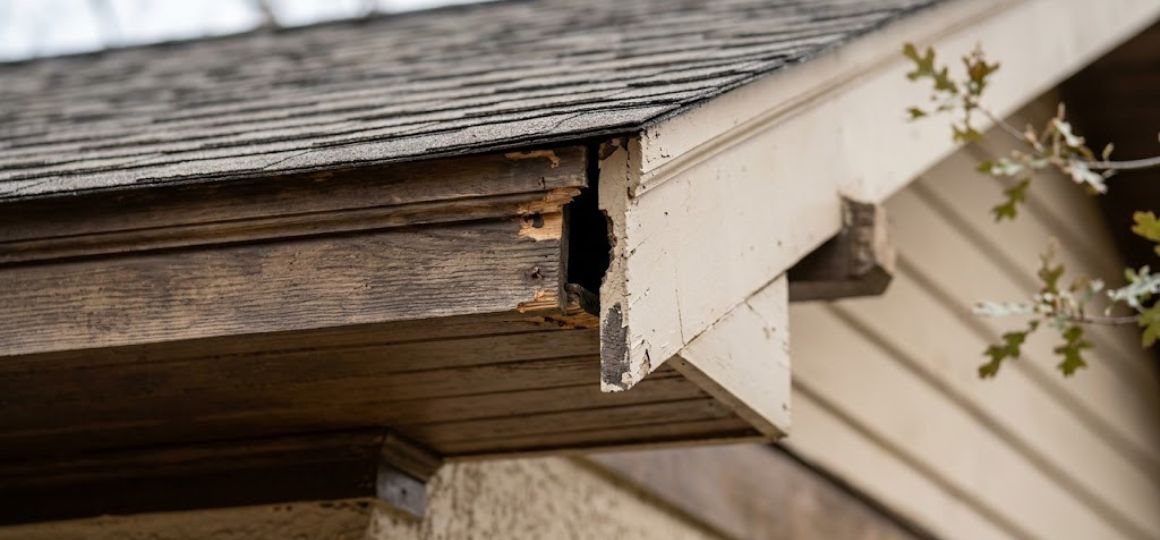
Why older Greensboro homes are at disproportionate risk
Soffit gaps are the top entry. Where the roof meets the wall.
Gable vents are next. Old screens rust out. Birds make holes.
Gable vents, the most common entry in pre-1970 homes
Roof-edge lift happens with age. Shingles loosen. Gaps open.
Bird-stop gaps let small rats in. Common on older eaves.
Chimney lids fail. Old caps fall off. Rats walk right in.
Soffit-return gaps, the entry point that gets worse every decade
Plumbing vent stacks have rubber boots. Boots crack with age.
We seal all of these. Steel mesh. Foam. Caulk.
Roofline penetrations, plumbing stacks, HVAC lines, chimney gaps
Every plumbing vent stack exits through the roof plane with a flashing collar. Over time, gaps make at the collar edge, between the flashing and the pipe. Between the flashing and the roof tops. A gap of 3/4 inch at a plumbing stack is a roof-rat entry point as viable as any gable vent. These gaps are often overlooked. They're not in the obvious "vent" type, they look like normal roofline hardware.
HVAC condensate and refrigerant lines often exit through outside walls near the roofline. The penetration was sealed at install, often with foam. That foam has degraded. The gap around the lines is now open. Roof rats that reach the wall face at roofline height will find and exploit these gaps.
Chimney chases in older Greensboro brick homes create a gap where the chimney frame meets the roof framing. A wood-to-masonry junction that opens as settling occurs. This is a less common but entirely viable roof-rat entry in homes with brick chimneys, mostly where the chimney chase has a wood-frame surround.
The canopy factor, why tree trimming is part of the solution
Sealing without canopy management is a partial solution in Greensboro's most affected neighborhoods. Roof rats reach the roofline via tree limbs, that's the delivery mechanism. Seal every current entry point with perfect hardware cloth and stainless-steel mesh, and the roof rats will pressure the sealed edge from the same limb contact points. They'll probe sealed areas repeatedly. Over time, if a seal has a weak point, they'll find it.
Removing limb-to-roofline contact, just any limb that touches or overhangs the roof, gutter. Soffit, breaks the delivery mechanism. Roof rats can jump a few feet but they can't fly. 6 feet of clearance between any tree limb and any part of the roofline or frame is the standard advice. We document which set limbs create contact in roofline checks and give that records for an arborist. Trimming doesn't replace sealing; it makes sealing more durable.
Material standards for roofline exclusion sealing
The mesh standard for roofline sealing is the same as for crawl-space sealing. 1/4-inch welded wire mesh, 19-gauge, galvanized or stainless. The difference is that roofline spots often is aesthetic considerations that crawl-space work doesn't. Galvanized hardware cloth oxidizes and makes a rust patina over time, acceptable on a foundation vent hidden behind shrubbery. Less acceptable on a visible gable vent on a 1925 craftsman in Irving Park.
Stainless-steel mesh in the same 1/4-inch specs oxidizes more slowly and keeps a cleaner appearance over time. For heritage homes in Greensboro's historic districts, Irving Park Historic District, Fisher Park Historic District. Stainless mesh in custom-fitted frames that match the first vent profile is the right material choice. It costs more. It's also the material that doesn't create an maintenance cycle where you're replacing corroded hardware cloth every 5-7 years on a historic home. Call (844) 635-0403 for a roofline checks and we'll walk through the specific entry points on your home.
The eight most common roof rat entry points in older Greensboro homes, ranked by frequency
Across years of roof rat work in Greensboro's older neighborhoods, the entry-point distribution follows a steady pattern. Knowing the order helps homeowners and inspectors focus attention on the highest-probability spots first:
1. First wood-framed gable vents from 1920s-1960s build used 1/2-inch screen mesh that has corroded, torn, or pulled loose from the frame over decades. The screen gap creates direct attic access. Visible from ground level on most homes by looking at gable-end vents through binoculars. The rusted or torn pattern is often clear.
2. Decades of seasonal expansion/contraction, water infiltration, and wood degradation create separation gaps that admit rats traveling along the roofline. Often impossible to see from ground level, needs ladder access or roofline check.
3. The resulting gap admits rats traveling the roof tops. Visible from the roof but not from ground level.
4. Less common in pre-1970 build (ridge vents weren't standard until later) but present in some renovated older homes.
5. Rats traveling the roof tops or climbing the chimney use these gaps for attic access.
6. At first foam-sealed at install; degraded over time. More common in homes that have had HVAC upgrades than in untouched first homes.
7. Less common than other roofline entry points because dryer vents are often below the canopy zone roof rats prefer. But possible in homes where the vent ends at gable-end height.
8. These are rare individually but worth checking on architecturally complex older homes where standard inspection coverage may miss set parts.
What fails first, predicting which entry points will develop based on home age and exposure
For Greensboro homeowners in older homes wanting to know which roof rat vulnerabilities to address proactively, the failure-order pattern based on exposure is reasonably predictable:
Years 0-15 post-build or post-renovation: often no roof rat vulnerabilities. New build materials in good state; no entry points yet made.
Years 15-25: first failures appear, almost always in gable vent screens (especially first wood-framed vents) and plumbing-stack collar boots. Both reflect materials degradation rather than frame settling.
Years 25-40: second wave includes soffit-return separations and flashing gaps. Frame movement and wood degradation drive both. This is the age where full roofline check becomes valuable, many points are starting to fail at once.
Years 40+: all roofline entry-point types are candidates. For Greensboro homes in Irving Park, Fisher Park, Aycock, Westerwood, and sunset Hills (most of which are 50-100 years old), check should assume any entry point can be present. The first build integrity is no longer protecting against rodent ingress.
The implication for proactive maintenance. A one-time professional roofline checks around year 20 of a home's age (or year 20 after a major renovation) is well-timed to catch first-generation failures before they become entry points. Greensboro homes in the 1990s-2000s build wave are reaching this checks-worthy age now.
Where roof rats nest, according to UC IPM
UC IPM says roof rats usually live and nest aboveground in shrubs, trees, or dense vegetation, and that indoors they favor attics, wall voids, ceiling voids, and cabinets. That is why roofline openings matter more for roof rats than for Norway rats, which burrow along foundations and stay near the ground floor.
The guide advises sealing cracks and openings larger than 1/4 inch and setting roof rat traps above ground, on ledges, shelves, branches, fences, pipes, or overhead beams, secured to the surface. The Wildlife Damage Management guide adds that wall vents should sit at least 40 inches above ground, fences, or shrubs, and that roof vents should be built on smooth sheet metal raised 40 inches or higher.
Source: UC IPM, Rats; Wildlife Damage Management, Rodent-Proof Construction
Related services
For older Greensboro home owners addressing roof rat issues, the directly applicable services are:
Got a rodent issue in Greensboro or Guilford County?
In roof Rat Entry Points in Older Greensboro Homes, What to Look For work, free inspections, same-day service where available, written quote before any work starts. Open 24/7.
Call (844) 635-0403