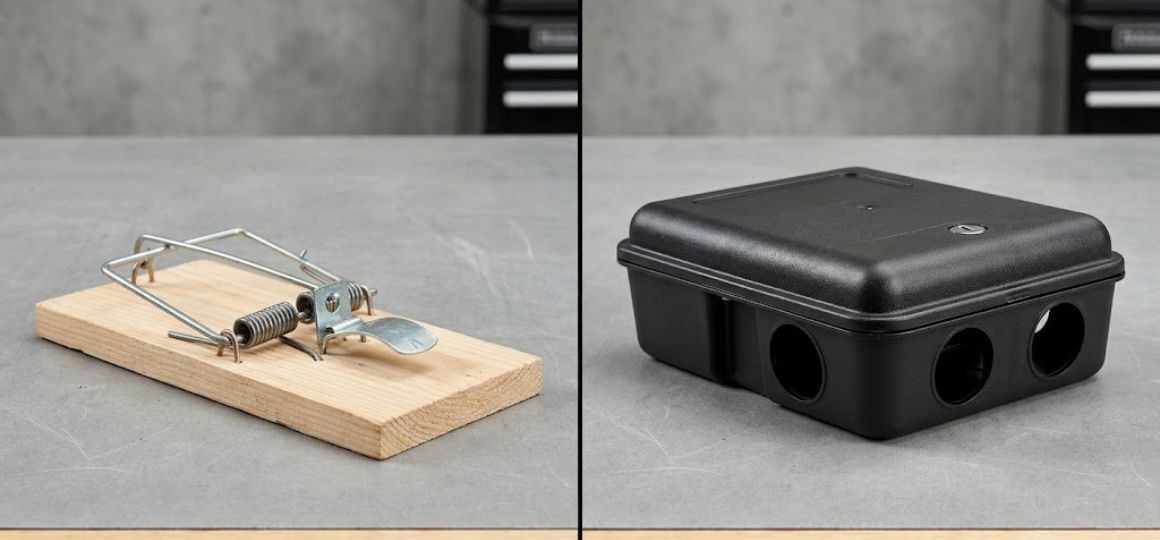
What snap traps do well, and what they can't do
But snap traps need to be checked. Dead bodies smell after a day.
Bait stations hold poison bait. Rats eat it. Go off. Die in walls or yards.
Bait works slower. Takes 4 to 7 days. Rats keep moving in the meantime.
What bait stations do well, and what they can't do
Bait is for large jobs. Outdoors. Yards. Business spaces.
Snap traps are for indoors. Kitchens. Attics. Garages.
We use both. Each has its place. We pick based on the job.
Locked stations keep pets and kids safe. Snap traps need to be out of reach.
Why interior bait placement is a mistake in Greensboro homes
This happens because placing bait indoors is faster and cheaper than deploying a properly positioned snap-trap network. It's also wrong for Greensboro home applications where children, pets, and family members are present, and where rodents dying in walls creates a second problem on top of the first.
The gap between inside and outside tool use is not just a preference. It's a risk-management principle. Snap traps for inside home environments. Bait stations in tamper-resistant housings for outside edge programs. Never bait loose inside a home.
The right combination for each Greensboro rodent scenario
Seasonal mouse influx in a Greensboro suburban home: Inside snap traps along confirmed travel routes (under sink, behind refrigerator, in garage) plus foundation sealing to close the entry. No bait station needed for a contained mouse problem in a lower-pressure area.
Set up Norway rat crawl-space infestation: Pre-baited crawl-space snap traps for the inside group plus outside tamper-resistant bait stations targeting the yard and storm-drain-adjacent source colony. Both tools running at once. Foundation sealing after crawl-space clearance is confirmed.
Roof rat attic infestation: Attic snap-trap network along confirmed travel paths. No bait station in the attic, recoverable carcasses are essential when working in an enclosed overhead space. Outside edge bait stations add value for homes with yard Norway rat pressure co-occurring.
Commercial restaurant with Norway rat pressure: Inside snap traps in back-of-house inaccessible areas (gear kick plates, utility chases, under dishwasher). Outside tamper-resistant bait stations at the building edge, dumpster enclosure, and alley adjacency. The split between inside and outside tools is the same, the only difference is scale. Call (844) 635-0403 if you'd like to discuss the right tool combination for your specific Greensboro home.
Side-by-side comparison: snap traps versus exterior bait stations
The detailed comparison across the dimensions that matter for home decision-making:
| Dimension |
|---|
| Primary deployment |
| Speed to result |
| Carcass recovery |
| Species confirmation |
| Pet/child safety in homes |
| Maintenance frequency |
| Effective range |
| Regulatory restriction in NC |
| Secondary poisoning risk |
| Cost per unit |
| Best use case |
Five common Greensboro scenarios, which approach for each
Translating the general framework into set decisions for issues Greensboro homeowners really face:
Scenario 1: Mouse droppings discovered in a single kitchen cabinet, no prior work history. Snap traps only, placed in the affected cabinet and one or two adjacent cabinets. Bait stations are overkill for a contained issue, and inside bait would be a mistake. Expected timeline to resolution: 5-10 days.
Scenario 2: Recurring Norway rat work each fall in a crawl-space-foundation home in Aycock or Glenwood.Both, inside snap traps (Norway-rat-sized) positioned along sub-floor travel paths in active phases. Outside bait stations against the foundation edge year-round to reduce the colonizing group pressure before it reaches the frame. The bait stations break the annual recurrence cycle that snap-traps-only never quite resolves.
Scenario 3: Roof rats in the attic of an Irving Park or Fisher Park home with mature canopy. Snap traps in the attic in active phases, the elevated spot doesn't suit bait stations, and outside bait below doesn't reach the canopy-traveling population. The longer-term solution for these homes is canopy-contact checks and limb trimming combined with attic-level sealing. Trapping is a phase, not the program.
Scenario 4: Commercial restaurant with ongoing pest pressure and health-check rules. Bait stations outside, monthly checks, full records. Snap traps inside only when active intrusion warrants. Restaurants often don't have ongoing inside trap programs in normal jobs because carcass-management within a food site creates secondary problems.
Scenario 5: Pre-buy check for a Greensboro home you're considering buying. Neither, check only. Trap and bait deployment isn't part of a pre-buy reviews. The goal is spot the frame vulnerability and any current population so the price can be worked out. After closing, if the check found active issues, you choose the right intervention based on what was found.
Maintenance cycles, how the two approaches differ over time
Beyond the initial deployment, snap traps and bait stations have very different maintenance burdens that affect their practical usefulness over months and years of job.
Snap traps need frequent check.A snap trap that has captured an animal must be cleared and reset within a few days. Left longer, the carcass attracts secondary scavengers (flies, beetles) and creates odor. A snap trap with a degraded bait load (most baits lose result within a week or two of exposure) won't trigger reliably. For ongoing protection, snap traps demand a homeowner who will check them weekly. They're excellent for active response phases when work is being checked. But they're not a "set and forget" solution.
Bait stations need less frequent service but more discipline. A properly loaded bait station can run well for 30-90 days between service visits, bait integrity is preserved by the housing, and consumption patterns show when refilling is needed rather than fixed schedules. The trade-off is that bait stations need Tracking: which station was serviced when, how much bait was consumed in each interval, what trend the consumption is showing. A bait station program without proper records is just stations in the yard producing no info. Commercial accounts keep service logs precisely for this reason. Homeowners running their own bait-station programs often lose the records thread within months.
What the EPA and UC IPM say about bait stations
The EPA says consumer rodenticide products are now sold as ready-to-use bait stations with block or paste bait. Pelleted baits are no longer permitted in consumer products, and second-generation anticoagulants are no longer registered for consumer use. Professional labels require tamper-resistant stations wherever children, pets, or nontarget wildlife may reach the bait, and for all outdoor above-ground applications.
UC IPM gives practical trap guidance: place rat traps about 10 to 20 feet apart, use a pea-sized amount of bait, and set them close to walls and in dark corners where activity shows. It also advises minimizing entry points before any outdoor baiting. Whichever tool you choose, read the label and check local rules.
Source: EPA, Restrictions on Rodenticide Products; UC IPM, Rats
Related services
For Greensboro households evaluating the right method, these are the directly relevant services:
Need help with rodents in Greensboro or Guilford County?
In snap Traps vs. Bait Stations for Greensboro Homes, When to Use Which work, free inspections, same-day service where available, written quote before any work starts. Open 24/7.
Call (844) 635-0403